
Ailanthus: A Hidden Threat and Replacement Strategy
Ailanthus altissima, or Tree of Heaven, is an aggressive invasive species that actively displaces native flora, damages the urban landscape, and creates a false sense of greenery. Although it provides shade and is drought-resistant, the harm from reduced biodiversity and infrastructure damage outweighs its benefits. Simply cutting down the trees is ineffective and even harmful, as it provokes vigorous growth of suckers. To solve the problem, Yerevan needs a strategy that includes inventory, chemical treatment of stumps, and immediate replacement of Ailanthus with sustainable native species such as hackberry or ash.
The Scale of the Problem and a Legacy of the Past
In Yerevan, Ailanthus, often called the "Chinese sumac," has become a familiar part of the background greenery. While there is no precise inventory data at present, a visual inspection reveals a significant presence of the species. It dominates vacant lots, industrial zones, and residential courtyards in the Kentron and Arabkir districts, and it also sprouts through cracks in the asphalt along roads.
It is important to note that modern municipal greening services do not officially use this species in new planned plantings, understanding its status. The presence of mature trees in parks and squares is explained by the fact that in past decades, Ailanthus was actively planted intentionally. It was valued for its rapid growth and ability to green the city in a short time. Today, we are dealing with both the legacy of those plantings and their offspring, which spread by self-seeding in areas lacking regular maintenance.
How to Recognize the Enemy: A Guide for Citizens
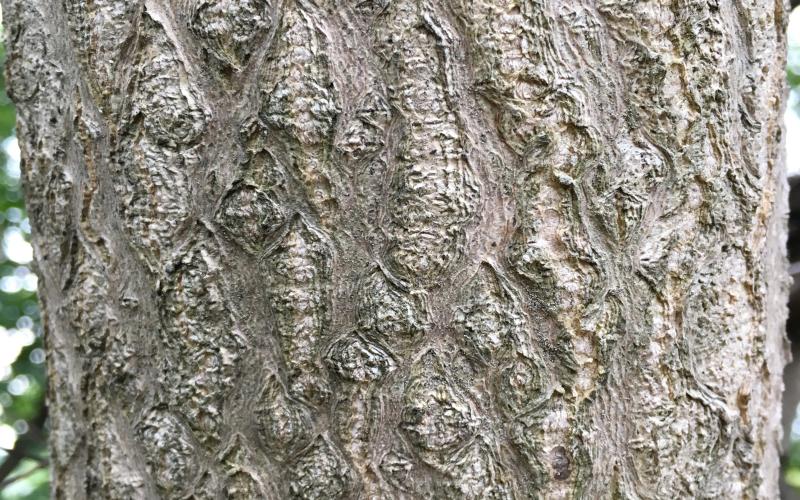
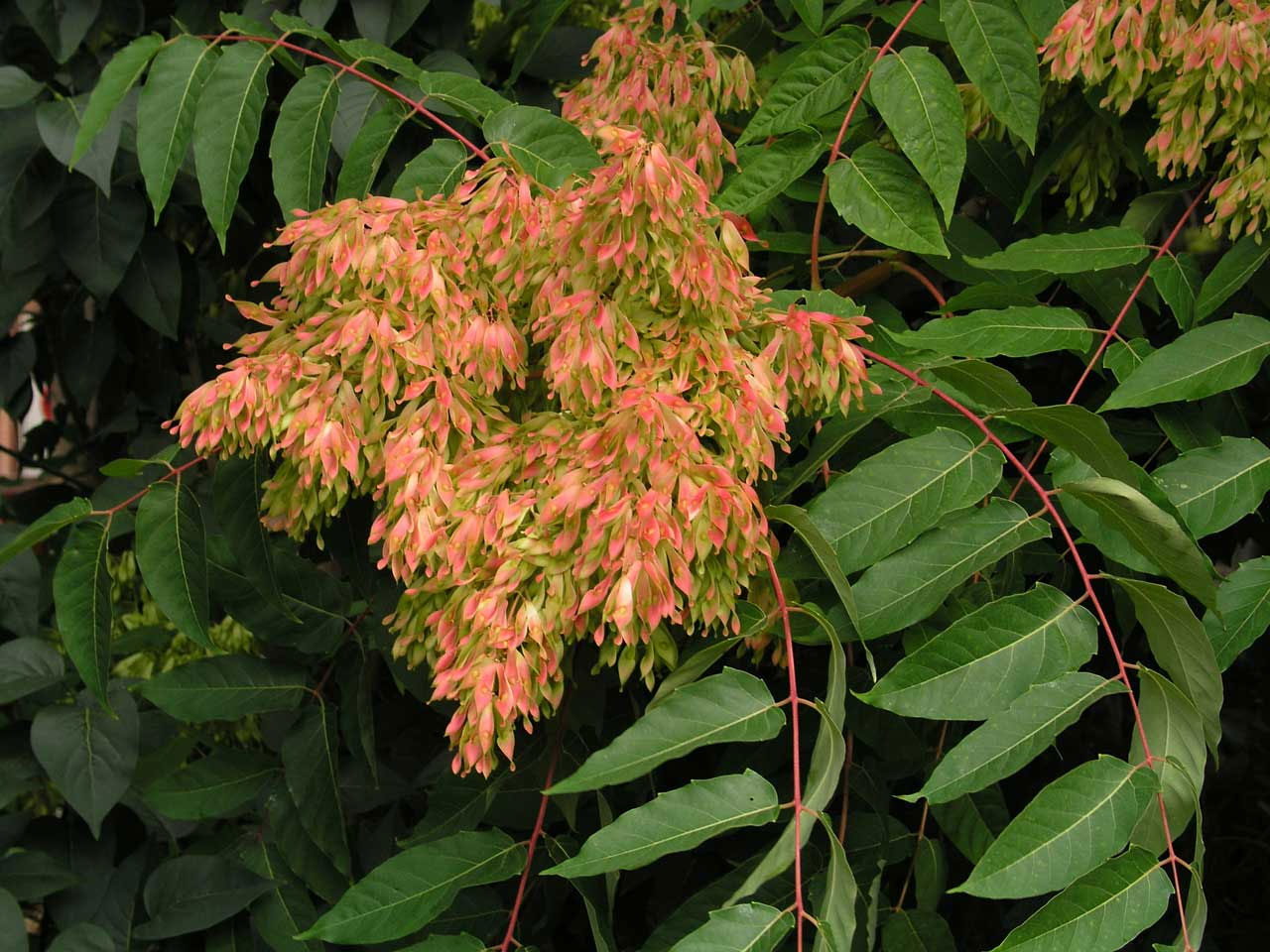
To quickly identify Ailanthus, one only needs to look closely at the trunk and crown. The bark of mature trees resembles the skin of a cantaloupe: it is gray with a characteristic diamond-shaped pattern of light-colored cracks, but it never peels off in large pieces like that of a plane tree. Another sure sign, especially noticeable in the cold season, is the huge clusters of reddish-brown winged seeds (samaras) that often remain on the branches all winter. The main difference from the similar-looking ash tree lies in the structure of the seed: in Ailanthus, the seed is located strictly in the center of a twisted wing, whereas in the ash, it is offset to the edge of a long, flat "blade."
Biological Impact on the Ecosystem
The main danger of Ailanthus lies in its ability to wage chemical warfare against other plants, a process called allelopathy. The roots and leaves of the tree excrete a toxic substance—ailanthone. It suppresses the germination of seeds and the root system growth of native plant species. Studies conducted in Europe and the United States confirm that the concentration of ailanthone in the soil under a mature tree is sufficient to create an exclusion zone for competitors.
Ailanthone remains active in the soil for a relatively short time, usually a few months. This is an important factor that offers hope for ecosystem recovery after the invader is removed. The soil does not remain permanently poisoned, and reclamation is possible.
If the tree is left untouched, however, it forms monodominant stands. In such zones, neither native grasses, nor shrubs, nor seedlings of other trees can survive. This leads to the creation of a so-called "green desert." Outwardly, the area looks green, but it is poor in insect and bird species, as it does not provide them with their usual food source.
Impact on Public Health
In addition to environmental damage, Ailanthus poses a certain threat to human health, although it is not the absolute leader among allergens in our region. Pollen from male plants can cause allergic reactions. Its effect is comparable to the reaction to ash or olive pollen but is less aggressive than that of the plane tree or cypress, which are also widespread in Yerevan.
A more serious problem is contact dermatitis. The plant's sap contains irritating substances. If it comes into contact with the skin during pruning or when branches are damaged, it can cause irritation and rash. Medical literature describes rare cases of inflammation of the heart muscle (myocarditis) when the sap enters the body through mucous membranes, which requires caution when working with the tree. Furthermore, the specific unpleasant smell of male flowers during the blooming period reduces the comfort of the urban environment for residents of nearby buildings.
Why It's Safe at Home and Is It Useful at All?
In its native China, Ailanthus is kept in check by natural pests and diseases that have co-evolved with it over millennia. In Armenia, it has no natural enemies, which allows it to expend all its resources on growth and reproduction rather than on defense.
At the same time, it cannot be denied that Ailanthus performs basic ecological functions. It grows extremely fast, creates dense shade, reduces surface temperatures, and is able to survive in conditions of monstrous soil and air pollution where linden or oak trees would perish.
There is a professional opinion that in zones of extreme industrial pollution, far from residential areas where land reclamation is impossible, the use of Ailanthus is permissible as a temporary technical measure for soil stabilization. However, in a residential city with a valuable ecosystem, the risks of its uncontrolled spread are too great.
Adequate Replacement and Native Analogs
To replace Ailanthus, it is necessary to choose trees with a similar habit (crown shape) and high resistance to Yerevan's urban environment. The closest and safest analogs are the Caucasian hackberry (Celtis caucasica) and the Southern hackberry (Celtis australis).
The hackberry has a powerful root system capable of strengthening slopes, is extremely drought-resistant, and provides good shade. Visually, it resembles Ailanthus but is a native species friendly to the local flora.
Excellent replacements also include the Common Ash (Fraxinus excelsior) and the Terebinth Pistachio (Pistacia mutica). These trees have historically grown in the Yerevan basin. They support local biodiversity by providing food for birds and insects, which Ailanthus does not.
Global Experience in Control
The problem of Ailanthus expansion is not unique to Yerevan. New York, Berlin, Rome, cities in Australia, and southern Russia have all faced it. Global experience unequivocally shows that simple mechanical removal (cutting down) does not work.
Ailanthus has a colossal capacity for vegetative regeneration. This is its defense mechanism: after the trunk is cut, the root system receives a distress signal and sends out dozens of new shoots at a great distance from the stump. These shoots grow even faster than the parent tree, turning a single tree into a dense thicket of shrubs.
Cities that have succeeded in controlling the population use a combined method. First, chemical treatment is carried out. Herbicides are injected directly into notches in the trunk or applied to the fresh cut immediately after felling. This allows the substance to penetrate the root system and kill it, preventing the formation of suckers. Only after the roots are dead can one speak of successful removal. Without the use of specialized agents, the fight against Ailanthus becomes an endless and costly process.
Summary and Recommendations
Ailanthus altissima is a dangerous woody weed that threatens the biodiversity of Yerevan. Its advantages in terms of unpretentiousness are nullified by its aggressive territorial expansion, soil poisoning, and destruction of infrastructure with its powerful roots.
To rectify the situation, the city is recommended to take the following steps.
First, the problem must be officially recognized. A clear distinction must be made between areas where Ailanthus is a legacy of the past and areas where it is spreading by self-seeding.
Second, the simple felling of live Ailanthus trees without prior or simultaneous chemical treatment of the stumps must be strictly prohibited. The current practice of mechanical removal often only exacerbates the situation by stimulating root suckers.
Third, a phased replacement program is needed. Old Ailanthus plantings in parks and on streets should be systematically replaced with hackberry, ash, and pistachio. This will restore the city's natural ecological character and reduce future maintenance costs. Only a systemic approach will preserve the city's unique ecosystem.